Environmental Scientist Courses
Environmental Scientists protect natural resources and advise on sustainable practices by conducting research, impact assessments, and community education.
AI Exposure
High

AI exposure data adapted from Felten, Raj & Seamans (2021). Shortage data sourced from Jobs and Skills Australia (2024).
View all courses
How do I become a Environmental Scientist
Get qualified to work as a Environmental Scientist with a course recognised across Australia. Speak to a training provider to learn more.
Duration
3 years - 3 and a half years
Study mode
Blended, On Campus, Online
If you’re passionate about the environment and building a sustainable future the Bachelor of Environmental Science opens doorways into professional career paths and community advocacy opportunities. You could become a teacher, park ranger, environmental advisor, researcher, or sustainability officer in either private enterprise or government.
The degree covers: environmental biodiversity, earth systems, surveying and spatial sciences, data acquisition and analysis, environmental chemistry, sustainable ec...
Career opportunities
Duration
3 years - 3 and a half years
Study mode
Blended, On Campus, Online
Find a provider
Study mode
Blended, On Campus, Online
The Bachelor of Science (Honours) (Environmental Science) provides an immersive exploration into the multifaceted world of environmental challenges. By facilitating a profound understanding of pressing issues, this course empowers students to devise and implement solutions. It integrates theoretical learning with hands-on experiences, ensuring that students are well-equipped to make meaningful contributions in the field. With a focus on both knowledge and application, graduates are poised to become leadin...
Career opportunities
Study mode
Blended, On Campus, Online
Find a provider
The Graduate Diploma in Environmental Management is designed to cultivate analytical and strategic skills essential for addressing critical worldwide issues, including climate change, pollution, and land clearing. This course enables learners to develop and apply strategies that effectively balance social equity, environmental sustainability, and economic demands. It focuses on imparting essential techniques and methodologies crucial for resolving issues related to sustainable development, equipping stude...
Career opportunities
Study mode
Blended, On Campus
The Bachelor of Advanced Science (Honours) (Earth Science) teaches scientific techniques for sustainable management of the Earth's minerals, energy sources, and natural resources. Students learn to use remote-sensing technologies and geographic information systems (GIS) to analyse geological processes and monitor environmental changes. The course offers deeper exploration of topics such as mineral and rock analysis, mining geology, environmental geology, and geochemistry, equipping students with compr...
Career opportunities
Study mode
Blended, On Campus
Find a provider
View all
Related career opportunities
Browse occupations related to Environmental Scientist.
Common questions

How much do Environmental Scientists earn?
The average salary for Australian Environmental Scientists is currently $2,250 per week ($117,000 annually). These are median figures that include the salaries for new graduates as well as experienced scientists.

What are the job opportunities for Environmental Scientists?
There are approximately 26,300 Environmental Scientists employed in Australia right now. They work for construction companies, energy and resources corporations, conservation organisations, academic institutions, government departments and agencies such as the Environmental Protection Authority (EPA), the CSIRO, and the Department of Environment, Land, Water and Planning. Some Environmental Scientists are self-employed consultants.

How do I become an Environmental Scientist?
To work as an Environmental Scientist in Australia you will need a Bachelor of Science (Earth and Environmental Systems) or Bachelor of Environmental Science and Management. You will also benefit from post-graduate studies in a specialist field such as climate and weather, agriculture, plant and soil management, fisheries, oceanography, ecology, geology, and more.
Source: Australian Government Labour Market Insights 2023
Choose a field of study

Want to make a difference in the world by creating sustainable workplaces and communities? Find out how at Courses.com.au.
All courses

Pursue careers as Park Rangers, Land Managers, and Conservation Managers, making a lasting impact on the environment. Pathways for domestic and international students.
Career opportunities
View all

Learn to monitor and enhance sustainability practices across industries, paving the way for a greener future. Pathways for domestic and international students.
Career opportunities
View all

Discover your passion for marine conservation and turn it into a rewarding career with nationally recognised training courses. Pathways for domestic and international students.
Career opportunities
View all
All courses
More information
Environmental Scientists are passionate about the natural environment and aim to protect and conserve wildlife, plants and forests, fishes, natural resources, and cultural heritage sites. They carry out field tests, modelling, and environmental research then advise governments and private enterprises on the most sustainable ways to carry out their operations.
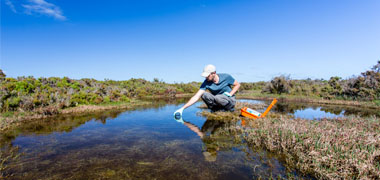
As an Environmental Scientist you could be carrying out environmental impact assessments for a construction company, analysing the impact of pollution on local soil and water quality, writing a report on the decline in native plant species in national parks, developing an operational procedure for local government to prevent unlawful land clearing, participating in an environmental focus group that addresses illegal discharge of wastewaters, or running community programs to educate the general public about the impacts of climate change.
To succeed in this occupation you will need a thorough knowledge of environmental science and the research methodologies in your specialist field, as well as the ability to present meaningful reports and recommendations to key decision-makers and stakeholders.

Courses by location