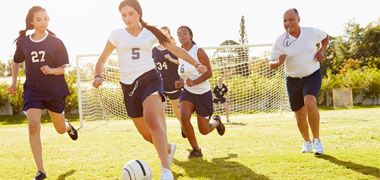
Sports Scientist Courses
Sports Scientists advise athletes and coaches on performance improvement, conducting assessments and developing tailored training and recovery plans.
AI Exposure
Low

Core skills such as social intelligence and complex physical tasks remain beyond the capabilities of current AI.
AI exposure data adapted from Felten, Raj & Seamans (2021). Shortage data sourced from Jobs and Skills Australia (2024).
View all courses
How do I become a Sports Scientist
Get qualified to work as a Sports Scientist with a course recognised across Australia. Speak to a training provider to learn more.
Study mode
Blended, On Campus, Online
The Bachelor of Football (Development, Management and Performance) develops the skills and knowledge needed for a wide range of football careers. You will explore various football codes and learn how they apply best practice in coaching, leadership, community participation, management, and high performance. Designed with industry input, classes are taught by experts using real-life case studies. Practical experience in football environments is a key feature, helping you build confidence and gain valuable ...
Career opportunities
Study mode
Blended, On Campus, Online
Find a provider
Study mode
Blended, On Campus, Online
The Bachelor of Sport and Exercise Science prepares students for careers in providing physical activity services across various community sectors. This course imparts a robust understanding of the principles and mechanisms in sport and exercise science. Students gain the knowledge and skills essential for managing and planning activities in health, exercise science, sport, event management, and exercise therapy contexts, equipping them to effectively contribute to the field of sports and exercise.
Career opportunities
Study mode
Blended, On Campus, Online
Find a provider
Study mode
Blended, On Campus, Online
The Graduate Certificate in High Performance Sport equips students with the knowledge and skills necessary for enhancing the conditioning of high-performance athletes. This course focuses on optimising individual and team performance within a multidisciplinary environment, considering its culture and leadership structures. It emphasises ethical practices characterised by respect, equity, and social justice. Ideal for those seeking to contribute to high-performance sports, the course prepares students to e...
Career opportunities
Study mode
Blended, On Campus, Online
Find a provider
Duration
6 months - 12 months
Study mode
Distance, Online
The Graduate Certificate in Sports Medicine provides core knowledge in diagnosing, treating, and managing exercise-related injuries. It covers fundamental aspects of sports medicine, such as identifying and treating acute and overuse injuries, injury prevention, rehabilitation, and biomechanics. This course equips you with the skills to treat a diverse range of individuals, including amateur sports enthusiasts, elite athletes, children, and those with disabilities or of advanced age, making it valuable in...
Career opportunities
Duration
6 months - 12 months
Study mode
Distance, Online
Find a provider
View all
Related career opportunities
Browse occupations related to Sports Scientist.
Common questions

How much do Sports Scientists earn?
Salaries for ESSA-accredited Sports Scientists in Australia range between $62,000 per annum (entry-level graduates) and $100,000 (senior positions). Exercise & Sports Science Australia (ESSA) is our country’s peak industry body for sports and exercise professionals.

What are the job opportunities for Sports Scientists?
There are no clear employment figures for Sports Scientists working in Australia right now. They are employed by professional athletes and sporting teams, gymnasiums, sports centres, healthcare organisations, government agencies, universities and academic institutions. Some Sports Scientists work as independent consultants.

How do I become a Sports Scientist?
To become an ESSA-accredited Sports Scientist, you must complete an approved Bachelor’s degree such as the Bachelor of Exercise and Sport Science, Bachelor of Human Movement, Bachelor of Science (Human Movement), or Bachelor of Health Science (Sport).
To advance your career you will need a Master’s degree. Suitable qualifications include the Master of Science (Sport & Exercise), Master of Sport and Exercise (Research), and Master of Applied Sport Science.
Source: Australian Government Labour Market Insights 2023
Choose a field of study

Have a passion for sports and fitness? Set your career on the right track with an accredited course in sport, fitness and recreation. Start today!
All courses

Community recreation courses are ideal for those looking to work in sports, fitness and recreation roles in the community. Education pathways for domestic and international students.
Career opportunities
View all

Fitness courses are designed to prepare students with everything they need for careers as personal trainers and fitness instructors. Start today!
Career opportunities
View all

Turn your love for the outdoors into a career or advance job prospects with an accredited course in outdoor education. Pathways for domestic and international students.
Career opportunities
View all
All courses
More information
Sports Scientists provide expert advice to professional athletes and their coaches. They can work in either professional practitioner roles (providing one-on-one consultations with clients) or as dedicated researchers (opening up new bodies of knowledge that improve athletic performance).
As a Sports Scientist you could be having an initial meeting with the coach of a football team to discuss their performance shortfalls, helping a swimmer refine their strength-based training plan, conducting a physical fitness and movement test with a professional runner, recording a cyclist’s race results and analysing historical data, or developing a recovery plan for a tennis player who is injured.

Courses by location